Views: 0 Author: Site Editor Publish Time: 2026-11-10 Origin: Site
Fast firing maximizes production throughput in modern manufacturing facilities. It also significantly narrows the margin for error during glaze maturation. This tight operational window often leads to costly yield losses. Surface defects quickly degrade product quality and erode profit margins. Floor tile glaze pinholes are micro-craters caused by escaping gases from the clay body. These trapped gases fail to heal over before the molten layer solidifies. This failure happens primarily during the rapid cooling phase of production. Our guide breaks down the mechanical root causes of pinholing. We examine this specific issue within fast-fire roller kilns. You will learn how to evaluate firing curve adjustments accurately. We also provide a robust framework for sourcing optimized frit formulations to eliminate these stubborn defects entirely.
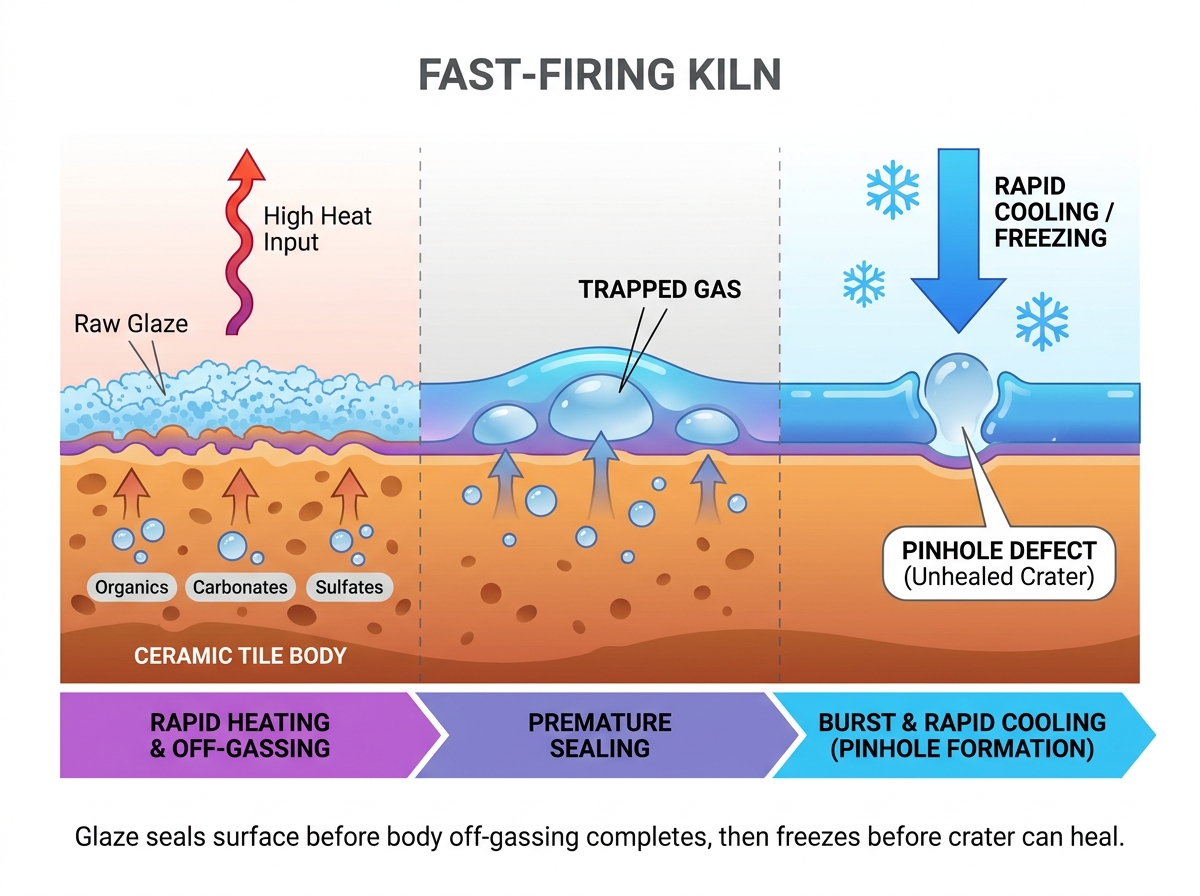
Pinholes in fast-fired tiles are primarily a timing issue: gases from the ceramic body or glaze materials evolve after the glaze has already sealed the surface.
Adjusting the firing schedule—specifically implementing a drop-and-hold technique—can allow gases to escape and the glaze to heal without sacrificing overall production speed.
Selecting the right glazed floor tile frit with appropriate melt fluidity and surface tension is critical for ensuring the glaze can heal over escaping gas bubbles before freezing.
Solving the defect requires a systemic evaluation of body composition, glaze application thickness, and kiln ventilation, rather than relying on a single "magic bullet" additive.
Surface defects directly impact tile grading outcomes on the sorting line. They reduce first-choice yield drastically. This erosion hits profit margins hard in high-volume manufacturing environments. Every rejected tile represents wasted energy and raw materials. We must understand the physical process behind these specific flaws.
As the tile body heats up, complex chemical reactions occur. Organics, carbonates, and sulfates decompose rapidly inside the kiln. They convert into various gases like carbon dioxide and sulfur dioxide. In fast firing schedules, the glaze often melts too early. It seals the tile surface before this crucial off-gassing process finishes. The body continues to release gas underneath a liquid glass layer.
This timing mismatch triggers the persistent gas entrapment cycle. The rapid cooling phase in fast firing complicates things further. It causes the molten glaze to freeze abruptly. A gas bubble might burst through the surface just before freezing. When this happens, the glaze lacks sufficient time to react. It also lacks the fluidity required to flow back and heal the crater. The result is a sharp, permanent pinhole on the finished tile.
Slowing down the entire firing cycle might seem logical initially. It allows ample time for degassing. However, this is rarely a viable business solution today. Production managers cannot sacrifice daily output metrics to fix a single defect. We must implement targeted interventions instead. These interventions usually focus on specific raw materials or distinct kiln zones.
We must establish a clear evaluation framework first. This isolates the specific variable causing the surface defect. Pinholing rarely results from a single isolated factor. You should systematically review the following three dimensions.
Body Composition Factors: Assess the carbon and sulfur content present in the raw clay. High-organic bodies demand much more oxidation time. They must finish burning out before the glaze begins to melt. If your clay supplier changes, organic levels might fluctuate unexpectedly. You must monitor these raw material inputs rigorously through regular laboratory testing.
Glaze Application Variables: Evaluate your glaze application thickness. Application thickness plays a massive role in gas entrapment. Thicker glaze layers naturally trap more ascending gas. They also require significantly lower viscosity to heal properly. You should check for excessive binder usage in the slurry. Binders introduce additional organic materials. These organics must burn off completely during the early firing stages.
Kiln Environment & Ventilation: Analyze the oxidation zone inside your kiln. Insufficient airflow prevents complete combustion of organic matter. This delays gas release substantially. The off-gassing pushes into the peak firing zone instead. Here, the glaze has already melted and sealed the surface. Upgrading kiln ventilation can often resolve this bottleneck immediately. Proper draft settings pull volatile gases away before they cause harm.
Altering firing curves is not always possible in busy plants. Production demands often lock these parameters in place. Transitioning to a more suitable ceramic tile frit is often the most scalable solution. Improved materials can mask minor process variations effectively.
A frit must balance melt fluidity against high-temperature viscosity. It must become fluid enough to allow gases to pass through easily. However, it must remain viscous enough to stay in place. If it becomes too fluid, the glaze will run off the tile edges. It might also pool unevenly in textured areas. Finding this exact chemical balance requires careful formulation.
Surface tension is another critical material metric. When sourcing a glossy ceramic frit for flooring, evaluate its surface tension characteristics thoroughly. Lower surface tension allows the molten glaze layer to level out naturally. It helps heal micro-craters much more efficiently. This healing must happen during the brief dwell time at peak temperature. Formulations high in certain alkaline earths often improve this leveling behavior.
Ensure the chosen glazed floor tile frit aligns perfectly with your body degassing temperatures. It should be formulated to melt after the majority of body off-gassing finishes. This delays the surface seal intentionally. It provides a crucial window for trapped gases to escape unharmed. You can verify this alignment using a heating microscope in your laboratory.
Modifying the roller kiln curve requires precision and patience. You want to alter the temperature profile without drastically reducing total throughput. Small adjustments often yield significant improvements in surface quality.
We recommend optimizing the oxidation zone first. Extend the time spent in the pre-heating and oxidation zones. Alternatively, increase the temperature slightly in these specific areas. This ensures all organics burn out completely early on. They must combust before the glaze flux fully activates and melts.
The drop-and-hold technique is a highly effective intervention strategy. You drop the temperature slightly immediately after peak firing. You then hold this slightly lower temperature for a brief period. This allows the glaze to remain fluid enough to heal. Crucially, it stops any further gas generation from the ceramic body underneath. The body stops reacting, while the surface smooths out.
Below is a breakdown of a standard fast-fire profile compared to a drop-and-hold schedule.
Firing Phase | Standard Fast-Fire Profile | Drop-and-Hold Profile |
|---|---|---|
Oxidation Zone | Rapid heating (20-30 mins) | Extended dwell (35-40 mins) |
Peak Temperature | 1180°C for 5 minutes | 1185°C for 3 minutes |
Healing Phase (Post-Peak) | Immediate rapid cooling | Drop to 1150°C and hold for 4 minutes |
Final Cooling | Aggressive ambient air quench | Standard ambient air quench |
You must watch out for severe adoption risks. Do not over-fire the glaze in a desperate attempt to smooth out craters. Excessive heat can trigger severe blistering across the tile surface. It can also cause a noticeable loss of opacity in white glazes. In extreme cases, over-firing leads to refractory degradation inside the kiln.
Evaluating frit suppliers for industrial-scale production requires strict criteria. A reliable vendor prevents massive production headaches down the line. You need partners who understand high-speed manufacturing environments.
Batch-to-batch consistency stands as your absolute highest priority. You must demand strict quality control data from your chosen vendor. Minor variations in frit chemistry can drastically shift the melting point. These subtle shifts can easily reintroduce defects onto your production line. Always review the supplier's internal firing logs for past batches.
Prioritize vendors who offer robust on-site technical support. They should help match the frit formulation directly to your specific clay body. They must also tailor it to your unique fast-fire kiln profile. Off-the-shelf solutions rarely work perfectly in complex industrial setups. The best vendors send technicians to tune the application on your actual line.
Consider the following next-step actions before signing a procurement contract:
Request multiple sample batches from the potential supplier for initial screening.
Conduct rigorous gradient firing tests in your laboratory to map the melting range.
Analyze the results for ideal melting behavior and low surface tension.
Run pilot line trials to validate performance at scale under real production speeds.
Verify the final aesthetic and technical specifications against your quality standards.
Eliminating micro-craters in fast firing requires a careful, systemic strategy. You must balance production speed directly against material chemistry. There is no simple shortcut to achieving flawless surfaces at high volumes.
The most sustainable fix involves comprehensive process alignment. You align the firing curve's oxidation phase with the correct raw material. You need a properly formulated, low-surface-tension frit. This combination effectively prevents premature surface sealing while allowing gases to escape.
We encourage production teams to take immediate action today. Begin by auditing your current kiln ventilation systems for proper draft. Next, request optimized frit samples from your trusted suppliers. Use these samples for comprehensive gradient testing in your facility to find the perfect match.
A: Pinholes are small, open craters where gas has successfully escaped. Blisters are trapped gas bubbles situated just beneath the surface. They may or may not have broken open. Both defects share similar root causes. However, they occur at distinctly different stages of the melting process.
A: Yes, reducing application thickness can help. It decreases the physical distance gas must travel to escape. It also reduces the total volume of molten material needing to heal. However, thinner layers may negatively impact the final aesthetic or reduce long-term wear resistance.
A: Traditional firing allows many hours for organics to burn off. Gases escape completely before the glaze even begins to melt. Fast firing compresses this entire timeline into mere minutes. This rapid heating often causes the glaze to seal while the body is still off-gassing.
A: Not necessarily. Increasing temperature makes the glaze much more fluid. This increased fluidity aids the healing process initially. However, excessive heat can also trigger entirely new gas-producing reactions deep in the ceramic body. This secondary off-gassing can potentially worsen the overall surface defect.