Views: 0 Author: Site Editor Publish Time: 2026-11-19 Origin: Site
In ceramic production and acquisition, the fine network of lines on a glazed surface carries dual meanings. They can either be a signature of artisanal mastery or a critical structural failure. This delicate visual boundary often confuses even experienced collectors and makers.
Determining the difference between intentional crackle glaze vs crazing is essential for quality assurance, product liability, and artistic integrity. While visually similar, one is a controlled aesthetic technique. The other is an unintended defect. This defect compromises the physical and hygienic integrity of the piece over time.
This guide provides a definitive evaluation framework. We will help you distinguish between decorative crackling and defective crazing. We also detail the underlying thermal mechanics, compliance risks, and implementation strategies for ceramicists and studio managers.
Intent dictates classification: A true craquelée glaze is intentionally formulated for controlled aesthetic outcomes, whereas crazing is a post-firing defect caused by a mismatch in thermal expansion.
Strict functional limitations: Neither intentional crackle nor unintentional crazing is considered strictly food-safe without specialized overglazing, due to bacterial harboring risks.
Durability degradation: Uncontrolled crazing reduces the tensile strength of the ceramic body by up to 75%, making it highly susceptible to thermal shock and mechanical failure.
Remediation requires formulation adjustments: Fixing a crazing issue requires modifying the silica/alumina ratio or adjusting firing temperatures to align the thermal expansion of the clay and glaze.
Ceramic surfaces speak volumes about the maker's control over their materials. You must understand the origin of surface fissures to properly classify them. We look primarily at the potter's intent and the predictability of the outcome.
Artisans formulate a true craquelée glaze specifically to craze predictably. They design it to shrink more than the clay body during the cooling cycle. This controlled tension results in beautiful, deliberate networks. You often see these described as "snowflake" or "ice crackle" patterns.
Makers intentionally manipulate these recipes. They want the surface to fracture in a uniform, pleasing manner. After the piece cools, artists often rub dark inks, metallic oxides, or strong tea into the fissures. This post-firing enhancement highlights the intentional aesthetic. It transforms a simple physical reaction into a celebrated artistic feature.
Conversely, unintentional crazing is an unplanned fault. It represents a failure in material compatibility. You might notice it immediately after pulling a piece from the kiln. Alternatively, it can develop months or even years later. Professionals call this delayed crazing.
You can identify this defect by its erratic, unevenly spaced fault lines. They follow no deliberate pattern. They look random and disruptive. Crazing represents an unresolved tension state between the glaze layer and the underlying clay body. It means the materials are fighting each other.
Best Practices for Distinction: Always evaluate the consistency of the pattern. Deliberate crackle covers a piece uniformly. Accidental crazing often clusters near rims, handles, or areas where glaze pooled thickly.
To master ceramic surfaces, you must understand thermal dynamics. The relationship between clay and glaze during heating and cooling dictates the final structural integrity.
Every ceramic material expands when heated and contracts when cooled. We measure this movement using the Coefficient of Thermal Expansion (CTE). A perfect clay-glaze fit requires a very specific relationship. The glaze must have a slightly lower CTE than the clay body.
When the glaze contracts slightly less than the clay, it stays under compression. Ceramic materials are incredibly strong under compression. This slight squeeze actually strengthens the finished piece. It prevents accidental chipping and cracking during daily use.
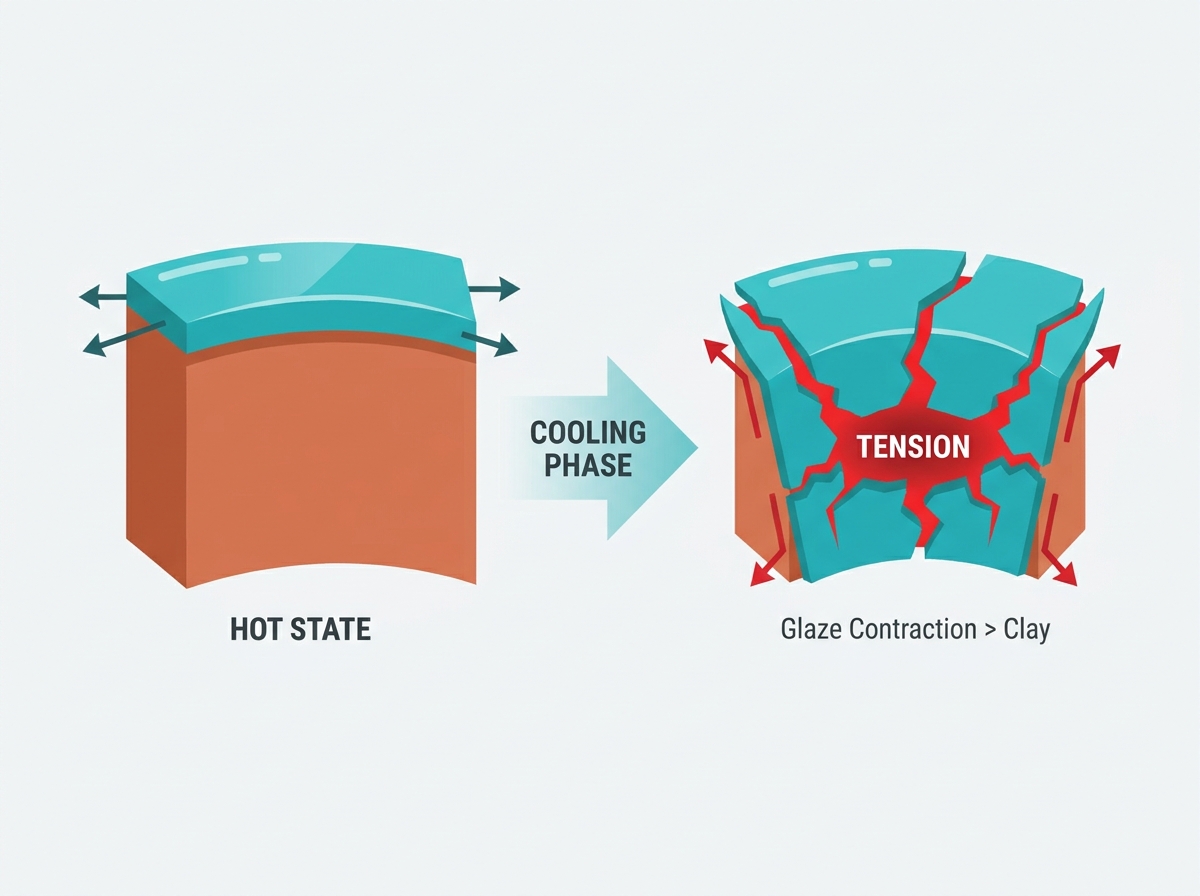
Defective crazing happens when we reverse this ideal relationship. The glaze contracts more than the clay body during the cooling phase. This mismatch places the glaze under extreme tension. Unlike compression, tension weakens ceramics.
Once this tension exceeds the tensile strength of the glaze, the glass layer fractures. It breaks to relieve the overwhelming stress. These fractures are the visible craze lines. They indicate a fundamental incompatibility in the material chemistry.
When formulating a crackle ceramic glaze, chemists purposefully leverage this mismatch. They deliberately introduce fluxes that inherently possess high expansion rates. Sodium and potassium are common examples. These ingredients guarantee the glaze will shrink dramatically upon cooling.
Application thickness also plays a crucial role in the mechanics. Thick applications typically yield larger, wider crack patterns. The tension builds up more significantly in a thick layer. Thin applications yield a much tighter micro-crackle. Makers control these variables to achieve their desired visual effects.
Table 1: Comparative Mechanics of Surface Fissures
Feature | Intentional Crackle | Defective Crazing |
|---|---|---|
Formulation Goal | High CTE deliberately engineered | Mismatched CTE unintentionally achieved |
Pattern Uniformity | Consistent, predictable network | Erratic, random, and uneven |
Chemical Fluxes | High sodium/potassium ratios | Unbalanced silica/alumina ratios |
Structural Impact | Acknowledged weakness, strictly decorative | Unexpected weakness, product liability |
You cannot judge a ceramic piece by aesthetics alone. Surface fissures carry significant functional consequences. Commercial potters and studio managers must rigorously evaluate these safety risks.
Any break in the glaze surface creates a porous environment. It does not matter if the break is intentional or accidental. This porosity directly conflicts with food safety standards. Regulatory bodies require culinary ceramics to feature an unbroken, easily cleanable surface.
Micro-fissures trap food particles. They also trap organic moisture. This creates an ideal breeding ground for bacteria. Routine hand washing cannot adequately sanitize these microscopic crevices. Consequently, pieces with surface fissures are unhygienic. They fail standard food-safe compliance checks.
Moisture seepage introduces another severe hazard. If the underlying clay body is not fully vitrified, it will absorb liquids through the crazing lines. This trapped moisture can lead to internal mold growth. Worse, it creates a serious microwave hazard. Trapped water turns to steam in a microwave, potentially causing the ceramic piece to explode.
Ceramics rely heavily on glaze compression for overall strength. A glaze under tension actively weakens the entire piece. Defective crazing drastically lowers the vessel's resistance to mechanical impacts.
Furthermore, it ruins the piece's resistance to thermal shock. A crazed bowl placed in a hot oven or a commercial dishwasher is highly likely to crack in half. The compromised surface simply cannot handle rapid temperature fluctuations.
You must implement strict shortlisting logic for product lines. Assess the intended function of every item you produce or purchase. Pieces featuring a high-expansion decorative glaze must carry clear restrictions.
Categorize these items strictly as "decorative only." Market them as vases, sculptural elements, or display pieces. Never sell them for culinary use unless they undergo specific remediation. They require sealing with a verified, unbroken, food-safe secondary transparent glaze over the crackle pattern.
Common Mistakes: Do not assume a piece is food-safe simply because you used a non-toxic glaze recipe. The physical structure of the fired surface dictates hygiene, not just the chemical ingredients.
Distinguishing between deliberate design and structural failure requires systematic testing. You cannot rely on a quick visual glance. Studios must implement a robust diagnostic framework before releasing products to the market.
Start your evaluation with careful observation and touch. These initial criteria quickly separate obvious defects from controlled techniques.
Pattern Uniformity: Examine the topography of the piece. Does the fissure network look deliberate? Is it evenly distributed across the entire surface? Controlled crackle shows consistent geometry. Accidental crazing looks chaotic and localized.
Edge Sharpness: Run a fingernail gently across the surface. Do the cracks feel sharp? Do they snag your nail? Sharp edges strongly indicate severe, ongoing crazing. A properly fired-over crackle usually feels much smoother, even though the visual lines remain visible underneath.
Visual checks are not enough. Microscopic defects often escape the naked eye. Implement the following physical tests to ensure quality and safety.
The Ink/Dye Test: Apply a washable marker, dark ink, or dye to a suspected area. Wipe it off immediately with a damp cloth. If the surface is truly solid, it wipes clean. Residual dye trapped in the surface reveals microscopic crazing that you could not see initially.
The Ping Test: Gently tap the rim of the ceramic piece with a wooden tool or your fingernail. Listen closely to the sound. A clear, resonant ring indicates proper vitrification and structural integrity. A dull, flat thud strongly indicates extensive internal crazing and a porous clay body.
Thermal Shock Testing: This is a destructive test. It accelerates delayed crazing, exposing poor clay-glaze fits before you launch a product. Submerge a test piece in boiling water for several minutes. Immediately transfer it to an ice-water bath. Repeat this cycle. If the piece crazes or shatters, the fit is fundamentally flawed.
When you identify unintended crazing, you must act decisively. Ignoring the problem leads to ruined inventory and damaged reputations. Studios must adjust their material formulas or alter their firing schedules.
Correcting an expansion mismatch requires basic chemistry adjustments. You want to align the CTE of both materials. Here are the primary methods for resolving tension defects.
Increasing Silica: Silica is your primary tool for altering expansion. Adding silica to the glaze recipe lowers its thermal expansion. Alternatively, adding silica to the clay body raises the body's expansion. Both adjustments push the glaze toward a safer compression state.
Adjusting Fluxes: Examine your flux ratios. High-expansion fluxes cause excessive shrinkage. Swap out heavy sodium or potassium for lower-expansion alternatives. Boron and lithium are excellent substitutes. They alter the CTE without drastically sacrificing the target melt temperature.
Firing Adjustments: Sometimes the recipe is fine, but the firing process is flawed. Try firing to a higher cone (temperature). This ensures complete vitrification of the clay body, maximizing its contraction. You can also incorporate a slower cooling cycle. Slower cooling gives the glass matrix time to settle and relieve internal stresses safely.
You must avoid lazy "band-aid" fixes. A common misconception suggests applying a thicker glaze layer prevents crazing. This is dangerously false. A thicker application actually amplifies the underlying expansion mismatch. It increases the tension forces. The crazing will likely appear faster and feature wider, deeper fault lines.
Meticulous documentation saves studios from disaster. Track your batch variations closely. Changes in raw material sources frequently disrupt stable studio recipes. A new bag of feldspar from a different mine can possess a entirely different CTE. This unexpected change can trigger severe crazing in a glaze that performed perfectly for years. Always test new material batches before committing to a full production run.
The boundary between an artisanal finish and a ruined batch relies entirely on control. We evaluate ceramic surfaces based on intention, predictability, and end-use safety. High-expansion decorative recipes offer immense aesthetic value. They elevate pottery into fine art. However, uncontrolled crazing remains a definitive structural failure.
Take proactive steps to protect your studio's reputation and your customers' safety. For creators, immediately implement rigorous thermal shock testing on all new clay and glaze combinations. Document your recipes and track your material sources diligently. For buyers and studio managers, strictly limit cracked-surface inventory to non-culinary applications. Adhering to these protocols ensures you maintain safety compliance while continuing to celebrate the unique beauty of ceramic art.
A: No, unless it is completely encapsulated by a secondary, unbroken, food-safe clear glaze. The cracks inherently trap organic matter, bacteria, and moisture. Routine washing cannot clean these microscopic fissures, making the surface unhygienic for culinary use.
A: Structurally, no. The tension mismatch is permanent. You cannot reverse the physical stress within the fired materials. The piece can potentially be refired with a different overglaze, but results are highly unpredictable and rarely viable for commercial salvage.
A: This is known as "delayed crazing." Moisture from the air slowly penetrates the microscopic pores of an unvitrified clay body. This causes the clay to expand slightly over time until the glaze eventually fractures under the newly created tension.
A: No. A thicker application actually increases the tension forces within the glass layer. If a glaze is prone to crazing, applying it thicker will often cause the crazing to appear much faster and feature wider, more severe fault lines.